The nurses in New York City are on strike, which is causing many nurses locally to reflect on the similar conditions they see in their hospitals. On Jan. 12, roughly 15,000 nurses walked off the job in New York City prompting hospitals to bring in thousands of temporary workers to allow operations to continue. Many nurses, locally and nationally are waiting for a federal policy change for more safe and fair work conditions.
The New York State Nurses Association called for a strike as negotiations for wage increases, health benefits, protection against workplace violence and safe staffing stalled for several hospitals across the state. The NYSNA is a union of 42,000 nurses and health care professionals and New York’s largest union. The NYSNA is an affiliate of The American Federation of Labor and Congress of Industrial Organizations, which is the country’s largest and fastest growing union for nurses.
Advertisement
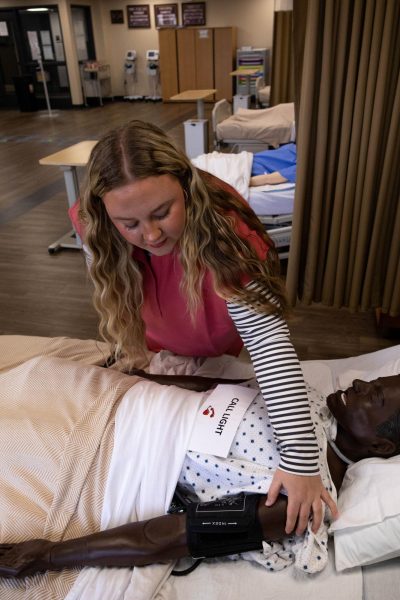
Nursing students are not excused from the hazards of the job, either. SIU nursing student Danielle Scott works as a med-surge, which is a specific type of surgical nurse who cares for patients pre and post surgery. Scott said that she has experienced understaffing already in her career within long-term care and nursing homes, which made working in a hospital setting more appealing to her.
Scott said there are dangers in her profession when it comes to understaffing.
“If we don’t have enough staff on a floor or to take care of those patients, it can be dangerous, we can be moving too fast, we can miss something we needed to see,” Scott said. “It is scary to think about, not being able to take 100% care that we want to give.”
Advertisement*
Workplace violence is a reason the nurses in New York are striking, and it’s a shared experience nationwide. According to the American Nurses Association, one in four nurses are experiencing violence on the job. This number is on the rise, according to the National Nurses United’s study on workplace violence, meaning nearly half of nurses have experienced workplace violence in the past year.
Scott said she has also experienced violence in the workplace, mostly in long-term care. Long-term care provides medical and personal support for patients who cannot live independently. This would include nursing homes, assisted living and memory care.
“There were times that I would come home from work, and I would be bruised and sore. I would have to come into work the next day and be okay with it.” Scott said. “A lot of it was people (who) aren’t in their right mental state…”
Because of previous experiences, Scott said she always finds herself asking if the person in the hospital bed is going to be potentially dangerous.
Kaelyn Watson, a pediatric literacy nurse navigator in Georgia has also had violent encounters with patients at workplaces.
Watson said she has seen and experienced workplace violence herself. This includes experiences of patients cussing, spitting, punching, kicking and throwing things at her. She said a family member of a patient once threatened to bomb the hospital where she was working. Watson recalled an incident in which a patient attempted to strangle one of her friends, a nurse, using his bare hands.
“(For) like six months, I had a patient kick me, punch me and spit in my face. And these aren’t the worst cases,” Watson said. “Nurses have been brutally beaten at the hands of patients. Nurses have died at the hands of patients. Nurses know violence comes with the job, but it shouldn’t and their employers should back them when it happens.”
While in long-term care, Scott said that she has seen burn out and experienced it herself.
“Every single day you would go in, and someone could call out, you can’t even be mad at them because they have maybe worked five or six days that week, and they are exhausted,” she said. “A lot (of nurses) have kids and families, it can be too much. You can’t take care of all those people and yourself too.”
Within less than a decade, there has been a shift in the way the U.S. government thinks about nurses. In 2020, during the height of the pandemic, nurses were recognized as “warriors” by President Donald Trump. On May 6, 2020, Trump proclaimed National Nurses Day emphasizing nurses’ dedication during COVID-19.
Now, barely five years later, the Trump Administration passed the Big Beautiful Bill, which no longer recognizes nurses as “professionals.” Since the Big Beautiful Bill was signed into law in 2025, The U.S. Department of Education removed nursing from the list of “professional” degrees. This means people that are wanting to pursue degrees in nursing are no longer eligible for higher loan limits afforded to other professions.
The nursing profession is also dominated by women, with 87.7% of registered nurses being women and 12.3% being men.
“It’s not the fact that we’re not considered ‘professional,’” Scott said. “It is the removal of support, and I think that in itself has made it a lot easier to blame nurses… A lot of women I know are doctors, but they are not always given the same status. I think maybe that is how the world works, which is frustrating and not okay, but I think that makes us easier to blame. Nurses who are, to society, maybe always perceived as a woman’s job.”
Scott also recognized that nursing can become a dangerous career, she said this is also acknowledged in class among her professors that have worked in the field. She said that it is not just the patients that can become violent, but some nurses are also around chemicals, biohazards and medicines all day — which can become dangerous.
Scott also resonated with many aspects of the nurses’ strike going on in New York.
“Honestly, it made me happy that they were taking a stand… There were so many times in the past working (in long-term care) where I thought the exact same thing,” she said. “I would think, ’I wish I was getting paid more than minimum wage for a job where I’m putting myself, my body, my mental (health) on the line every day.’”
While the strike continues in New York City, nurses across the country have stated similar concerns. Watson, who works now on a pediatric unit, has stated her concerns for the future of nursing.
Watson explained that she has experienced burnout in the workplace, leading her to fear she could not take care of patients like she wants to. She said that in previous work experiences, she has had to switch jobs because of burnout. Because she loves what she does so much, she wants to ensure her own happiness.
“You can experience pre-shift anxiety, shift anxiety and post-shift anxiety. It literally affects everything,” Watson said. “A lot of nurses end up having to shut a piece of yourself off when you walk in the door to the hospital to even make it through a shift. When this happens, you lose your empathy, your love of the job, your efficiency. You lose yourself. And losing all of that leads to nurses who are worn out, overworked, and mentally and emotionally exhausted. It destroys who you are not just at work, but at home.”
When hearing about the New York nurses’ strike, Watson said that the staffing issue resonated the most with her past experiences.
Watson explained that there are no national standards for staffing in nursing. Union hospitals have set ratios, but it doesn’t always happen where the ratio is true to the job. Watson explained while working at Saint Louis University Hospital in med-surge, the ratio should have been one to four, but she worked with more patients that night because they did not have the proper staff. Watson explained that this happens less in pediatrics, but it can still happen.
Although there are no staffing regulations in nursing currently, changes will be made this year under the Joint Commission. The Joint Commission, an organization that focuses on healthcare quality and patient safety, will formally recognize nurse staffing as a national performance goal, requiring hospitals to meet specific staffing benchmarks.
Watson also expressed her concern for the future of her career under the Trump administration. Robert F. Kennedy is the current U.S. Secretary of Health and Human Services, and he has made changes to the childhood vaccine schedule and major claims regarding vaccines for children and adults.
Regarding the childhood vaccine schedule, Kennedy cut the requirement of vaccines from seventeen to eleven. Kennedy cut vaccines such as influenza, COVID-19, rotavirus, Hepatitis A and B, meningococcal disease prevention and respiratory syncytial virus vaccine.
Kennedy has previously claimed, which several professionals denounced, that the MMR vaccine, a shot used to help prevent measles, mumps and rubella, is made from “a lot of aborted fetus debris.” Kennedy has also claimed without evidence that childhood vaccines cause autism, a claim that has been debunked, and he has spasmodic dysphonia because of the flu shot, which medical experts said his not based in science.
“Before my current role, I was working in the pediatric intensive care unit. Pediatric health care feels like it’s under attack,” Watson said. “I think the biggest hurdle is more people are not vaccinating their children due to this administration’s suggestions. I’ve been in pediatrics for the last six years and you would see the occasional anti-vax family. Now, you’re seeing so many more. This is not scientifically backed, and it’s putting so many kids and adults at risk.”
Staff Reporter Mariah Fletcher can be reached at [email protected] or on Instagram @mariahonrecord
Advertisement