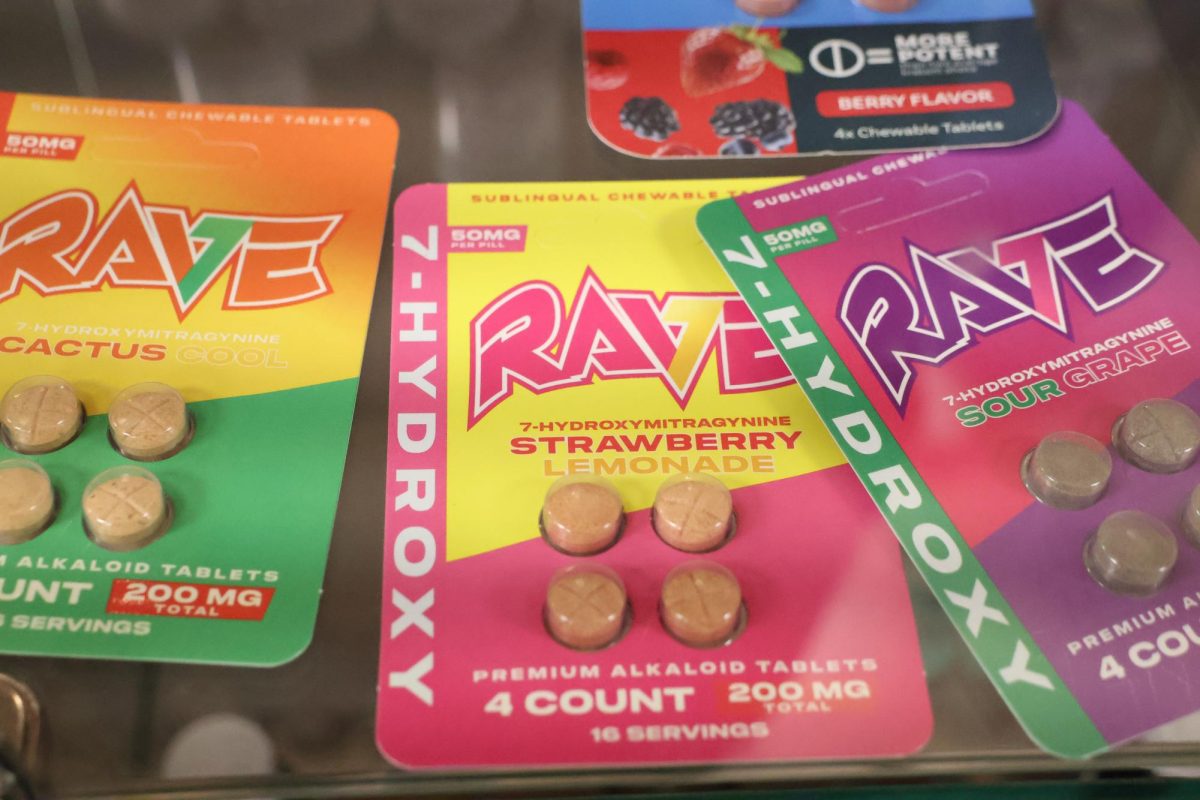
The Jackson County Board’s ordinance banning the sale and distribution of kratom and kratom-based products in unincorporated areas went into effect Jan. 1. The move comes as local officials raise concerns about the substance’s potential health risks, particularly among youth and other vulnerable populations.
Kratom is a plant-derived substance sometimes sold as an herbal supplement. In low doses, it can act as a stimulant, while higher doses produce sedative effects. Kratom is not approved by the Food and Drug Administration and the agency recommends that the public avoid using kratom for medical purposes until its safety can be further evaluated since products are not standardized, and the potency can vary between brands and stores.
Advertisement
Federal agencies, including the FDA, Centers for Disease Control and Prevention and National Institute on Drug Abuse, have linked the substance to seizures, liver damage, rapid heart rate, respiratory issues and, in some cases, hospitalization or death.
Jackson County Board Chairman C.J. Calandro described the ordinance as a proactive measure to safeguard public health in a press release.
“Our goal is to prevent avoidable harm and make sure people have accurate information about substances that can be dangerous,” he said.
Advertisement*
Under the ordinance, it is now illegal to sell, distribute or give away kratom in unincorporated areas of Jackson County. Officials allowed a period of advance notice before enforcement to give businesses and residents time to remove products voluntarily.
The Jackson County Health Department did not provide comment when reached by the Daily Egyptian.
Kratom is sold directly to consumers through a variety of outlets. Specialty stores, such as head shops, apothecaries and smoke shops, commonly stock these products along with herbal supplements and other smoking-related products and accessories. Some convenience stores also carry kratom, and it is available through online retailers that ship from regional or national distributors.
Several local areas have already taken similar steps. Most recently, Murphysboro passed a city ordinance Oct. 28 banning both the sale and possession of kratom following a unanimous vote by the City Council.
Other nearby communities, including Marion and Herrin, have also enacted bans or restrictions on the sale and distribution of kratom, continuing a growing regional trend among local governments to address unregulated substances ahead of any statewide action.
The City of Carbondale has not enacted any jurisdiction concerning kratom.
Carolin Harvey, mayor of Carbondale, said that currently there are no regulations in Carbondale regarding kratom, and when the issue was previously discussed on the City Council agenda, no action was taken.
With Jackson County and other municipalities moving to restrict kratom, some users in the region have noted the impact on accessibility. Residents in banned areas who use the substance may need to travel to neighboring areas to obtain it, particularly after bans in places like Murphysboro, Marion and Herrin.
Some local business owners who sell kratom say that regulation, rather than prohibition, would better address safety concerns.
Rachel Phelps, owner and operator of CBD Wellness Center in Carbondale, said her perspective is shaped by more than two decades working in the cannabis and plant medicine industry and six and a half years working with kratom.
“I’m fairly politically involved in not just kratom but in cannabis too, and fighting the good fight, so to speak,” Phelps said. “The whole movement around cannabis was to get the medicine in the hands of the people in the most affordable, safe way possible. And there’s not as much attention and movement around kratom, so what I found is there’s a lot of off the hip reactions out of fear and uneducated fear reactions.”
Phelps said there is limited research available on kratom and how different strains or products affect individuals, which she said makes education especially important. She said their shop promotes responsible use of the plant by providing them with accurate description of what the plant is, along with safe consumption methods, and they limit sales to those 21 and older.
“Although there isn’t much official research to pull from, the plant has been used medicinally for hundreds of years, so there is that history to draw from and also from that of the last six and a half years of my experience with it,” Phelps said. “We do not claim to be experts on the plant but do set an example on how it can remain available to the public in a responsible way.”
She said her approach to kratom mirrors the one she has used with cannabis, emphasizing consumer education and cautious use.
“We are known for education and a primary focus on safe consumption,” Phelps said. “We arm them with that, and then allow them to make a choice for themselves.”
A study published in 2025 in Volume 27 of the journal Current Psychiatry Reports noted that people who use kratom may rely on unsubstantiated anecdotal recommendations from people who use the substance without background research, which can potentially increase the risks of the product if using highly concentrated alkaloid products.
Phelps also said testing and oversight for products sold to consumers is fundamental to buyers’ health and safety.
“Just like with cannabis, having third-party lab-tested products is what’s most important,” she said. “This will show potency and purity, there’s those two parts to that. To have a lab that is not affiliated with the wholesaler or the retailer means they don’t have an arm in the game.”
Phelps said there is a significant distinction between traditional kratom products and more concentrated formulations.
“There is a huge difference between very concentrated 7-OH products and liquid or powdered kratom,” she said. “So that is starting to get convoluted and mixed up and misunderstood.”
Some kratom products on the market contain higher concentrations of 7-hydroxymitragynine, often shortened to 7-OH, an alkaloid that occurs naturally in the kratom plant and is associated with stronger opioid-like effects.
Kirk Evoy, a Clinical Associate Professor in the Pharmacotherapy Division of the College of Pharmacy at The University of Texas at Austin, contributed to the Current Psychiatry Reports study.
In an email to the Daily Egyptian, Evoy wrote, “Mitragynine is the primary active component of kratom and provides relatively weak opioid effects if taken at high enough doses. However, many newer kratom products contain semi-synthetic 7-hydroxymitragynine or mitragynine pseudoindoxyl, which don’t naturally occur at high levels in kratom…These produce strong opioid effects and carry much greater risks of opioid-like side effects and overdose.”
In recent years, products with elevated levels of 7-OH have become more widely available, particularly in concentrated forms, which has added to concerns among public health officials about potency and consumer awareness. Because kratom products are not regulated or standardized, the concentration of alkaloids can vary widely between products.
The Current Psychiatry Reports study noted that “while whole leaf kratom products typically produce minimal respiratory depression risk, more potent alkaloids like 7-hydroxymitragynine may produce respiratory depression at higher doses.”
“The average person walking into a smoke shop or gas station and buying kratom likely doesn’t understand this difference,” Evoy wrote. “Furthermore, many of these products are not clearly labeled with their contents or the amounts of specific alkaloids…such that even if the person did have a good understanding of the differences between the different alkaloids they still might not be able to tell what is in the product they just bought.”
He wrote that he thinks the more potent semi-synthetic products containing 7-hydroxymitragynine or mitragynine pseudoindoxyl are too dangerous to be sold as over-the-counter drugs and should be banned for the time being.
“I think increased regulation of the manufacturing and package labeling of kratom products is extremely important, as this will allow people to better understand what they are actually consuming and provide more consistency among products, allowing for needed research to better understand their effects,” Evoy stated.
While acknowledging that kratom carries risks, Phelps said regulations like ID checks, testing, trained staff, and product labeling would be appropriate, but added that removing kratom altogether would do more harm than good.
“Our stance is, instead of banning it, let’s give it some safe regulation, because we know banning it doesn’t work,” she said. “It just pushes it underground. It causes people to use other means of treatment for themselves, which could be even more detrimental. So our stance is to have more regulation than prohibition.”
Restrictions in some municipalities have already affected where people purchase kratom.
“If they ban it, in like Herrin, Marion and Carbondale, it’s just going to scoot them to the next town,” Phelps said.
She added, many people use kratom medicinally and prefer plant-based alternatives to pharmaceuticals.
“I have many people in my customer base who don’t want to use man-made pharmaceuticals, so they would like to use a plant base that their body understands instead,” she said. “This includes people who are trying to manage pain or anxiety, veterans, recovering addicts and just general, everyday people from every walk of life that you can think of come to us and want to use the plant base instead of something that’s man-made.”
Clayton Jackson, a Carbondale resident who has been using kratom for about five years, said he began using it to help manage an alcohol addiction. He uses kratom primarily for an energy boost, noting that some users take it for different reasons, such as pain management or relaxation.
“The main thing I like it for, is I like it for energy. Some people use it for other reasons, but I just like the boost it gives me,” Jackson said. “Add it with a little caffeine and makes the day a lot better.”
Evoy warned that combining multiple psychoactive substances can greatly increase the risk of overdose or other serious side effects.
“Given that kratom has both stimulant and opioid-like effects, I would say it is particularly concerning to use it alongside other stimulants, opioids, or substances like alcohol that can further depress your central nervous system,” he wrote. “In these cases, it is likely that using kratom would increase your risk of overdosing on these substances, even at doses you might be able to tolerate if taken alone.”
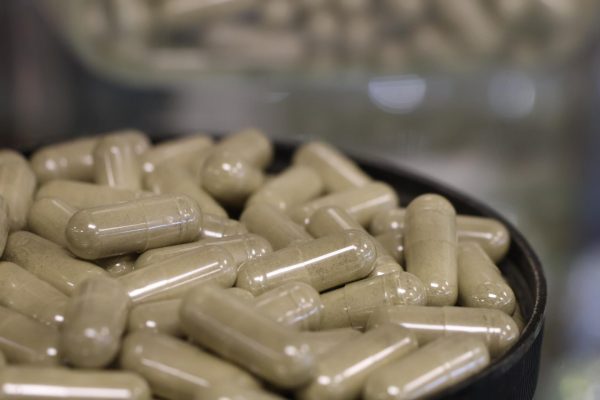
Kratom comes in several forms, including powders, capsules, leaves for tea or to chew and extracts. Jackson has tried different forms of kratom but said he prefers the powder form.
“I’ve tried capsules, but I think powder is a lot easier on the stomach than the capsules,” he said.
He discovered kratom at a local shop and did not know it was an option to use before then.
“I just stumbled across it in the head shop one day and just kind of went from there,” he said.
He also spoke about the practical impact of bans in other municipalities.
“Banning kratom makes it hard,” Jackson said. “I was living in Marion when Marion banned it, and it’s my vice so I had to start driving to other places to get it and everything else. It’s inconvenient.”
Jackson acknowledges the risks associated with the substance.
“I think there’s misconceptions about kratom just in the fact that obviously it can be dangerous,” Jackson said. “A lot of people use it to handle heroin issues. It’s still a safer alternative, but, I mean, there’s definitely some dangers. That’s why I switched to capsules, since it gave me stomach problems. It’s the lesser of two evils for me.”
Staff reporter Annalise Schmidt can be reached at [email protected]
Advertisement