Editor’s Note: This story was originally published with Gateway Journalism Review.
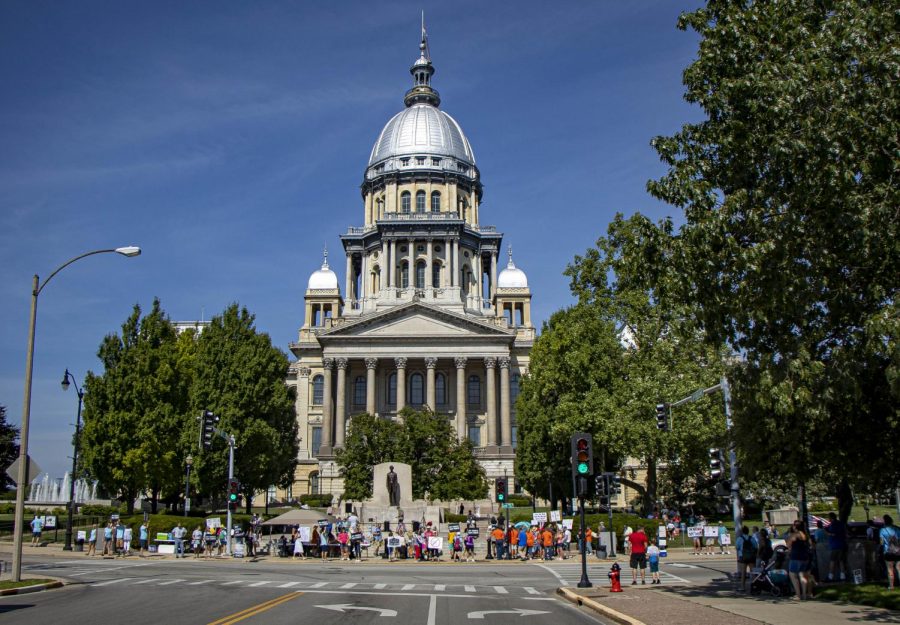
The decision by the Associated Press to close its Springfield bureau is the latest sign of a decades-long decline in statehouse journalism, leaving fewer reporters to scrutinize Illinois government as news organizations nationwide continue to shrink their state capitol coverage.
Advertisement
The Associated Press this spring ended its permanent reporting presence in the Illinois Capitol, where longtime correspondent John O’Connor covered governors, lawmakers and state agencies for nearly three decades. The move reflects broader changes in the news cooperative’s coverage strategy, with greater emphasis on enterprise, video and data journalism while relying more on partnerships for routine legislative coverage. O’Connor could not be reached for comment.
The closure is also the latest example of a decades-long decline in statehouse journalism. Newspapers and wire services have steadily reduced Capitol coverage, leaving fewer reporters to monitor Illinois government and increasing reliance on nonprofit organizations such as Capitol News Illinois, which provides daily statehouse coverage to newspapers across the state.
“When we launched in 2019, it was John O’Connor, Bernie Schoenburg, Doug Finke and certainly others,” Capitol News Illinois Editor Jerry Nowicki said, referencing the statehouse reporters who were seen as leaders when CNI opened. “Those were the guys you looked up to for their knowledge of the system. Losing that, we lose a little bit as a press corps.”
Advertisement*
AP changed their news strategy throughout the years from generalizing their focus as the demand for statehouse reporting has decreased.
According to a YEAR report by the Pew Research Center, the number of full-time statehouse reporters has decreased by 34% in the United States.
They also found that “despite the decline, newspapers continue to employ more full-time statehouse reporters than any other kind of news organization.”
Molly Parker, a Southern Illinois University, Carbondale assistant professor who works for Capitol News Illinois said the non-profit is helping fill a gap not only at the Capitol but “across the state, with reporters in Chicago, the Metro East and southern Illinois, where I’m based.”
The statehouse is typically in session for five months in the spring and two weeks in the fall.
“It’s not a full time legislature, but a lot of us here in the press room are here full time year round,” said Dave Dahl, a broadcaster at the Illinois Statehouse. “So as that’s diminished, there’s been less of a priority by the AP in covering the legislature, and the constitutional officers, the governor, the whole bit. That’s not a good thing.”
While AP has been shrinking, this is the second downsizing the Illinois statehouse had in the last five years. The State Journal-Register has substantially reduced its newsroom over the past decade, though historical staffing levels for its statehouse bureau have varied over time.
“They have someone who kind of you know, comes in, but you can’t really do it unless you’re here a lot,” Dahl said.
One of the problems with the decreasing number of reporters covering the statehouse is stories have a higher chance of being missed or underreported.
“There’s so many issues to cover, so many issues to tackle and it’s really tough to get to anything even if you have multiple reporters,” Jeremy Gorner, a beat reporter for the Chicago Tribune who lives in Springfield half of the year to cover the statehouse.
The statehouse beat is expansive, Gorner said. “It’s coverage of the legislature, the General Assembly and Gov. JB Pritzker.”
Illinois has 177 lawmakers between its House and Senate. Roughly 12,000 bills are introduced every year. “I mean many of them have the same issues that they’re taking up, but there’s so many different ones too that could kind of fall under the radar very easily just because we have fewer eyes in the press corps keeping up with everything,” Gorner said.
Parker said that it is hard to watch that kind of reporting shrink over the years.
“The state government may not get the attention Washington does, but so many decisions that affect people’s daily lives are made in statehouses, city halls, county boards and school boards,” Parker said.
Investigative journalism at the statehouse also has diminished. Jason Piscia, the director of the 10-week graduate public affairs reporting program at the University of Illinois Springfield, said the statehouse could use more investigative and in-depth journalists to help uncover even more stories.
Piscia said that in the last 20 years, the number of students has gone up and down. “I went to the PAR program myself in the late ‘90s and there were more than a dozen reporters from various bureaus around the state, and little by little those news outlets cut their statehouse staff and the numbers have been very small the last several years,” she said.
Statehouse coverage has changed a lot in the last few years, especially for AP. “A lot of the broadcast features, they don’t do anymore, and I contacted them to ask for pronunciation of somebody and to complain. They rarely issue a pronunciation and their attitude was, yeah, we don’t do that anymore. Well, in broadcast, you have to know how to pronounce people’s names. It’s as important as spelling them,” Dahl said.
CNI has opened a lot of doors and jobs for statehouse reporting. “It’s just a changing environment. We’re glad we’re here to at least have people in the rooms and at the news conferences and asking the questions that might not get asked if we’re not here,” Nowicki said.
The budget is one such topic that Gorner said is important to keep eyes on.
“I think next year it’s gonna be $56 billion — not million — in the budget, and the public deserves to know how that money is being spent, and the public deserves to be able to scrutinize how that money is being spent,” Gorner said. “It’s a little difficult to do that when there are fewer eyes on the ball.”
When it comes to the future of statehouse reporting, “there’s lots to be optimistic about,” Piscia said. “Capitol News Illinois keeps growing… their staff numbers and they’re in there every day covering the day-to-day and what’s going on.”
Photo Editor Peyton Cook can be reached at [email protected] or on Instagram @cookmeavisual
Advertisement