Editor’s Note: Some students from Iran who spoke to the DE for this story requested to remain anonymous or to be referred to only by their first names because they fear persecution from the Iranian government or deportation from the U.S. government.
Story Correction: In the April 15 edition of the Daily Egyptian, the story titled “Iranian students at SIU react to the ongoing war at home” incorrectly stated that the Iranian Education Panel was hosted by Iranian students. The event was organized by the Carbondale Area Interfaith Refugee Support and co-sponsored by the International and Immigration Law Society and the Southern Illinois Chapter of the United Nations Association. The online story has been updated to correct these errors.
Advertisement
The United States on Feb. 28 launched a full-scale military attack on Iran in conjunction with Israel called “Operation Epic Fury,” which killed Iranian Supreme Leader Ayatollah Ali Khamenei and others — including civilians. In the aftermath of Khamenei’s death, Iranians — both in the U.S. and abroad — have taken to the streets to voice their opinions on the operation.
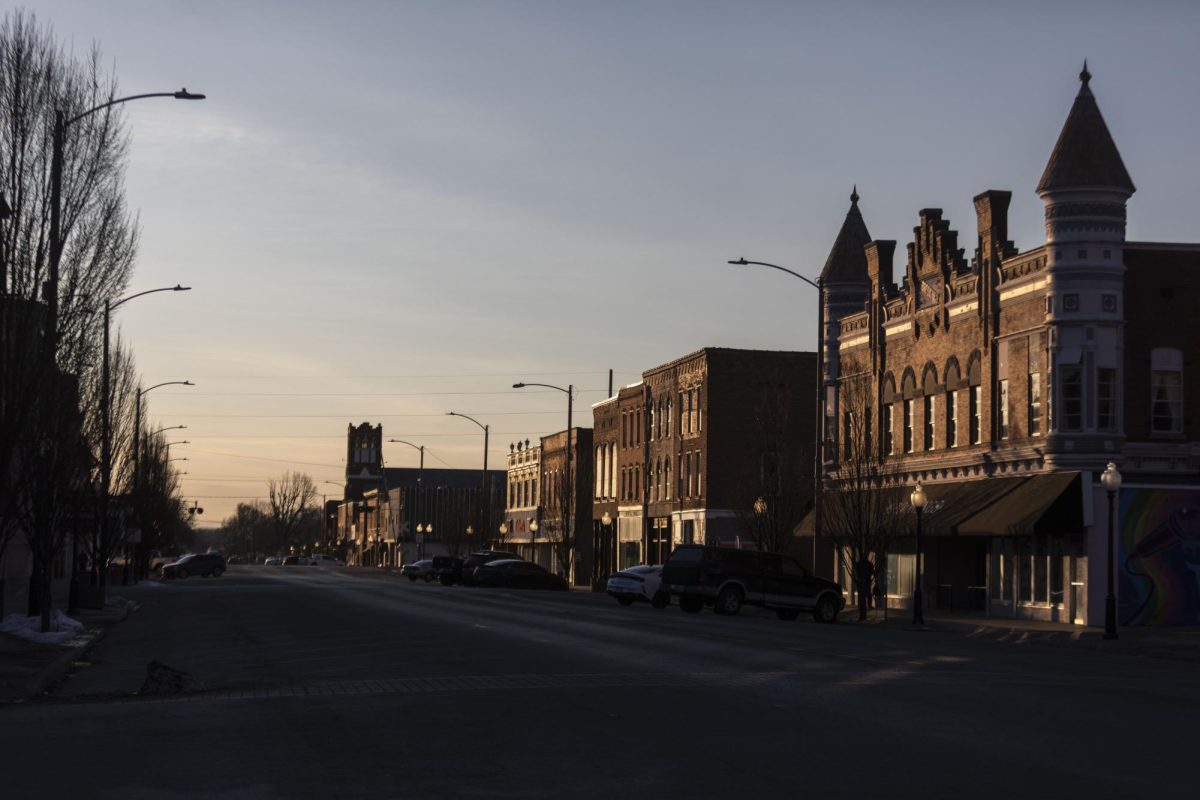
In southern Illinois, an Iranian Education Panel was held at The Varsity Center in Carbondale on Sunday, April 12, where the public was able to hear directly from Iranians in southern Illinois.
The event was an informational forum hosted by the Carbondale Area Interfaith Refugee Support Group and co-sponsored by the International and Immigration Law Society and the Southern Illinois Chapter of the United Nations Association that detailed the country’s history and included a panel of students from Iran who shared their own experience and thoughts.
Advertisement*
Ana, an Iranian PhD student that studies biology at Southern Illinois University, led the talk about Iran’s history, where the public learned about the country’s early civilization to its modern-day diaspora.
“The Iranian government uses the income of oil from Iran to fund religious sanctions,” Ana said.
Kahev, a PhD student studying agriculture, added that the current government “doesn’t spend money on Iranians.”
Ana explained that, not too long ago, Iran was a society much like the United States, where pop culture thrived, men and women dressed with the current fashion trends and both held seats in the government. It was not until the Islamic Revolution in 1979 that created the Islamic Republic of Iran that strict laws were enforced, especially upon women.
Ana said she was arrested when she was younger for not wearing her hijab. During the presentation, Ana brought up a notable case that happened in September 2022, when an Iranian woman named Masha Amini was killed from a head injury while being arrested by the morality police — local enforcers that actively search for those violating the law — for not wearing a hijab. Her death prompted many Iranians to protest in what was one of the largest the country had ever seen, according to PBS.
Asi, who lived in Iran for about 30 years, said that she was once arrested in Tehran, Iran even though she did not violate the hijab rule. According to her, the police said that they simply didn’t like how she was wearing it.
“They humiliate you and make you feel like you’re nothing,” Asi said.
Early in January 2026, Prince Reza Pahlavi, the son of the last Shah of Iran Mohammad Reza Pahlavi, led an opposition movement, advising Iranians to go out into the streets and protest. Many did, but were advised by the Islamic government that they would be treated as hostiles. According to Ana, the Islamic government is notorious for their methods of silencing protestors and anyone who speaks out against them.
What followed was what Ana calls a “democide,” the intentional killing of civilians by its own government. While the death count reportedly reached 23,000, Ana believes the number was much higher. The deaths were accompanied by a blackout in Iran that has prevented contact between Iranian families, she said.
Mina, a PhD student in mathematics, said she has been personally affected by the blackout.
“Two days ago was my mother’s birthday and I couldn’t call her because of the internet shutdown,” Mina said.
“When trauma goes up, tensions go higher,” Ana added. “We are hoping for a democratic party,” Ana said of what she hopes for Iran’s future.
Saba, a fine arts and media arts student, said that she tries to amplify Iranian voices through her work.
“Keep an eye on Iran and future generations, listen to the narratives, specifically now that the internet has shut down,” Saba said.
In interviews with the DE, a married couple who are both graduate students at SIU requested to speak anonymously because they feared persecution from the Iranian government
“If they knew we spoke out against them or attended rallies, they would kill us,” the couple said. “They will execute us — I am not joking.”
They recalled memories of friends being shot and killed in protests. One of them was never allowed to participate in protests because their mother feared that they would be killed, however they would still go, serving as a clinician for those injured.
“I was seeing the people in the clinic beaten and shot,” she said.
The other attended numerous events throughout their life, beginning in 1999 in the Iranian Student Protest. Most memorable to him was a June 20, 2009 protest after the death of an Iranian student, Neda Agha-Soltan.
An Iranian graduate student who grew up in Tehran said, “Mixing religion and politics is one of the most dangerous things in the world.
She recalled in school the customs that they participated in.
“We would shout Death to Israel and Death to America at the top of our lungs,” she said. According to her, this is one of many ways that the Iranian government has instilled its propaganda into the country.
Another SIU student from Iran said one thing in particular that bothered him about the topic was a misunderstanding of the difference between Iran and the Islamic Republic.
“Islamic Republic is the government that is heavily affiliated with the IRGC (Islamic Revolutionary Guard Corps), that is basically this tyranny and ideological dictatorship that is not only governing us, but also feeding a lot of terrorists and proxies, disabling the peace around the world,” he said.
The male student strongly urged how many Iranians were oppressed by the Islamic Republic, as well as opposed to them.
“The strongest thing that they have is the propaganda,” he said. “They have the ability to change the narrative.”
After the recent internet blackouts were put into effect, all students that were interviewed lost all contact with their family and are currently still struggling to maintain communication.
Two students both said they have severe anxiety about the well-being of their families and had difficulty processing the situation altogether.
One student said they would normally talk to their sister over the phone for about 10 minutes a day, as they are very close, but the blackouts made that difficult.
“The first day it was a shock, the second day I was losing my mind, and after three days I couldn’t function,” they said. “After a week I fell into a deep depression.”
They said that this semester was full of responsibilities, forcing them to pretend that everything was OK in front of other students and professors.
“The hardest part about it is coming home at night, where you have no one to pretend in front of,” they said. “Then it’s just you and you, that’s the hardest part.”
The student would read news of continued attacks, filled with fear of not knowing whether his family was safe or not.
During this time of anguish, the student noted how friends and colleagues were able to provide comfort and companionship. He credited Associate Professor Dust in Hoffman for being a major cornerstone of support who reached out and allowed him to “borrow an ear.”
“Knowing that people are here listening to you, that is a remedy,” the student said.
In an email to the DE, Hoffman wrote how he took the time to reach out and listen to the student speak in his office.
“I think that’s one of the most important things we can do — just to listen and learn and empathize,” Hoffman said.
Another student shared a similar sentiment. They explained how they shut down, and that it was difficult for them to process all that was going on. Fortunately, the student said that understanding advisers provided comfort during this time.
For both students, contact is still difficult as some civilians in Iran have to use Starlink or virtual private networks to communicate.
All students who were interviewed have actively participated in protests and advocate for the liberation of Iranians from the Islamic Republic through social media or other methods.
One student noted that in a protest in Carbondale, the reactions she got were mostly mixed, receiving honks in support from passerby. However, at one point during the protest, she recalled a man displaying a middle finger while shouting cusswords. She said she hopes that by using her voice, she can echo what she is seeing from civilian journalists and family members.
“Recently, the war for the first time is seen as the only last option to fight the regime and hope for liberation of the country from dictatorship,” the student said.
Staff Reporter Leo Castro can be reached at [email protected]
Advertisement