Since President Donald Trump took office last year for his second term, a federal effort to increase deportations and minimize immigration into the United States has led to an onslaught of legal battles, protests and political violence. Whether it concerns visa status or Immigration and Customs Enforcement activity, the constitutionality of recent federal action is being highly contested across the country.
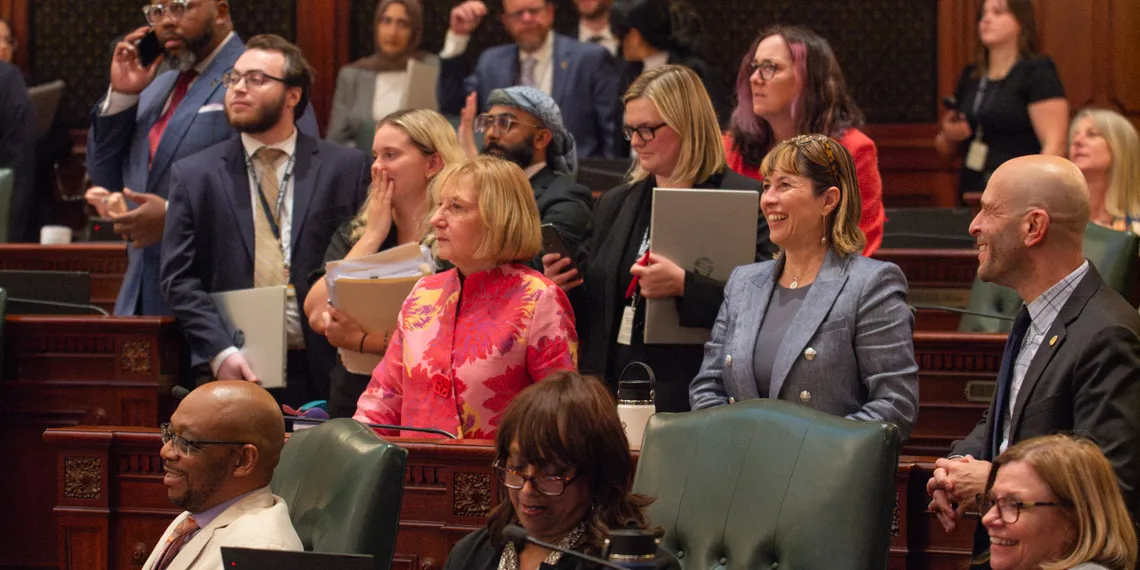
In light of this national discourse, a crowd of around 80 students, community members and professors gathered at SIU Simmons Law School on Wednesday, Jan. 14 for a lecture regarding ICE, immigration and new policies under the Trump administration.
Advertisement
Ohio State University’s César Cuauhtémoc García Hernández presented a lecture titled “Immigration Law in Turbulent Times” in which he describes recent events involving immigration through a legal lens. His lecture highlighted the increase in ICE raids across the country, clashes between civilians and agents that have led to shootings — like the fatal shooting of Renee Good in Minneapolis earlier this month — lawsuits, mass protests, the recent addition of 75 new countries to the U.S. visa ban list and the overall confusion concerning the legality of federal deportation practices.
Hernández’s teaching and writing details the intersectionality of criminal and immigration law and his lecture at SIU focused on the constantly evolving legal landscape that surrounds immigration enforcement techniques.
Attendees were able to speak with Hernández beforehand and ask questions after his lecture.
Advertisement*
In his lecture, Hernández spoke about Trump’s campaign, and how he specifically pledged to evoke a deportation operation similar to President Eisenhower’s 1954 military-style campaign aimed at ending undocumented immigration by deporting hundreds of thousands of Mexicans through mass raids and arrests throughout southwestern America.
Hernández detailed the non-fatal shooting of Marimar Martinez, a Chicago woman whose SUV allegedly struck an ICE agent’s vehicle in October of 2025, after which the agent fired five shots, striking Martinez multiple times. Martinez’s vehicle was “boxed in” by ICE vehicles during the time of the shooting, and is among many of the contentious incidents in which ICE agents have used lethal force while conducting raids.
“The head of the FBI called her (Martinez), a domestic terrorist,” Hernández said.
She was later charged with assaulting and impeding federal officers, but the government’s account was challenged with conflicting evidence, including body-camera footage and text messages from an agent. Federal prosecutors then dismissed these charges citing prejudice, which means the case cannot be reopened because of a weak or flawed case.
Hernández then spoke about the fatal shooting of Good, who was shot and killed by an ICE agent in January 2026 while in her vehicle as she engaged with agents during a neighborhood raid in Minneapolis.
“Good did not open the door. She did not exit the car. She continued driving it. First backwards, then forwards, then to the right. Then an agent, phone in one hand, shot her with a gun that he held in the other.” Hernández said. “The script repeats: Good is dead, and high level government officials say she is a domestic terrorist.”
Hernández also talked about the role that court case Terry v. Ohio plays during ICE raids. The 1968 Supreme Court ruling found it constitutional for police to “stop and frisk” without probable cause if they have reasonable suspicion that someone was involved in a crime.
Hernández said that Terry v. Ohio ties directly into a “turbulent time” on the west coast, with hundreds of ICE agents in the Los Angeles area. A district court in California recently responded to a lawsuit, Vasquez v. Noem (2025), that was brought by a group of people who were stopped and questioned by ICE agents. The plaintiffs believe they were racially profiled.
Hernández explained that the lawsuit, if successful, would prohibit ICE from racially profiling based on skin color, native language, accents, location or work/profession. A federal judge from California then agreed and issued an order restricting these tactics of profiling because it was a violation of the Fourth Amendment. The Supreme Court later paused the judge’s ruling, allowing ICE to continue those tactics.
Hernández noted that Brett Kavanaugh, a U.S. Supreme Court justice, is of the opinion that immigrants “often work in certain kinds of jobs, such as day labor, landscaping, agriculture, and construction, that do not require paperwork and are therefore especially attractive to illegal immigrants; and that many of those illegally in the Los Angeles area come from Mexico or Central America and do not speak much English.”
Kavanaugh was appointed in 2018, and has since written multiple court opinions about whether or not factors like race and ethnicity could be considered in immigration stops under the Fourth Amendment.
“How would an agent know that someone does not speak much English? How would an agent go about racially or ethnically categorizing a person?” Hernández asked, referring to Kavanaugh’s remarks regarding the Supreme Court’s hearing of Noem v. Vasquez. “Kavanaugh did not explain how agents were supposed to figure out those factors.”
Hernández explained that he and a friend, “just two brown-skin Latinos speaking Spanish” were having coffee.
“If we said one word to each other in English, it is one more than I can recall. If an immigration agent happened to be nearby, would they hear my conversation, not in English, and then decide that it must be because I cannot speak English?” Hernández asked. “What type of work would they decide I do? Would they assume that I am a tenured, full professor who holds an endowed chair at one of the country’s premier public universities?”
Hernández also spoke about the contingency surrounding the 14th Amendment, which states that people born of naturalized citizenship in the U.S. are citizens of the U.S. and that no state can enforce a law that can abridge the privileges and immunities of citizenship. Upon Trump’s second term, he challenged the interpretation of the 14th Amendment and what it means to be a “natural-born citizen” through an executive order. Trump argues that birthright citizenship should not automatically apply to children born to undocumented immigrants or parents without permanent legal status.
Hernández said that if this case is constitutionalized, “It will leave many of us without the U.S. citizenship we thought was woven into our legal DNA.”
In September 2025, the Supreme Court decided to hear the case. The court will likely not have a decision until mid-2026.
He closed his lecture with sobering remarks.
“We struggle to agree about whether what we see is real,” Hernández said. “We struggle to agree on whether the days are dominated by light or by darkness. We struggle to agree on whether the political storm in which we find ourselves is one of rejuvenation or one of decay.”
Hernández is currently the Gregory H. Williams Chair of Civil Rights and Liberties at Ohio State. Hernández has earned recognition as one of the top 10 most cited immigration law scholars in the U.S. Among being a scholar and author, Hernández is a former member of the ABA Commission on Immigration.
Simmons Law School Dean Hannah Brenner Johnson explained the importance of these lectures and continued conversations. She said the lecture was created in honor of the school’s founding dean, Hiram Lesar, whose work revolved around civil rights and public policy.
“I think at this particular point in our nation’s history, immigration is a very, very hot-button issue. So, it was very timely to bring a scholar in to talk about some of the constitutional issues that have arisen, and to also bring humanity to the problem as well,” Johnson said.
Attendee Sheila Simon, former lieutenant governor of Illinois and Simmons Law School professor, offered her perspective on Hernández’s lecture in an interview with the DE.
“I think it’s really important for them (law students) to hear the importance of conversation and the continued dialogue, and valuing the rule of law as a way to prevent violence,” Simon said.
Staff Reporter Mariah Fletcher can be reached at [email protected] or on Instagram @mariahonrecord
Advertisement