Editor’s Note: This story was produced for JRNL 412: Intermediate Photojournalism
Growing up in Jos, Nigeria, Bisola Saliu often watched planes from a nearby airport fly past her home. While she admired the job of pilots, she didn’t think much of it at the time. In fact, she graduated high school and went on to study chemical engineering. Two years later, she finally realized her true calling.
Advertisement
“I was good at it, but I didn’t like it,” Saliu said of engineering. “So I told my mom that I think I want to pursue aviation as a career.”
Saliu said that her mother was hesitant at first. There were no pilots in their family, and aviation can be expensive. But her mother ended up reaching out to her sister, who lives in Denver, and she invited Saliu to move to the U.S. and stay with her. Saliu said she began looking at large schools to attend like Embry-Riddle and the University of North Dakota, but ultimately decided to attend SIU because the school gave her the most financial support.
“I came here, and I actually don’t regret it at all,” she said. “My first semester, I lived in the LLC (Living Learning Community), so I had all aviation floor roommates and suitemates, and they were also women of color. So that was my first introduction to like, ‘Yeah, women can be pilots too.’ And I was like, ‘This is awesome.’ My journey here has had its ups and downs, but I had people to encourage me.”
Throughout her undergraduate journey, Saliu joined various organizations, where she said she found mentorship and sisterhood. She was a member of SIU’s chapter of Women in Aviation, which she still helps out with, and the Organization of Black Aerospace Professionals, which she’s now the faculty advisor of. She credits her former suitemate too, for introducing her to the group and being a supportive friend.
“Before coming to America, I knew I was a woman, I knew I was Black, but it wasn’t really part of my identity. I was just Bisola,” she said. “But then, here in America, I got classified as a Black woman, and sometimes it’s a really good thing and sometimes it’s a not so great thing. And so I and other professional women are trying to create that narrative that Black women, are professional, we’re here and we belong. And with the support of our white counterparts, too. We have people who support (us).”
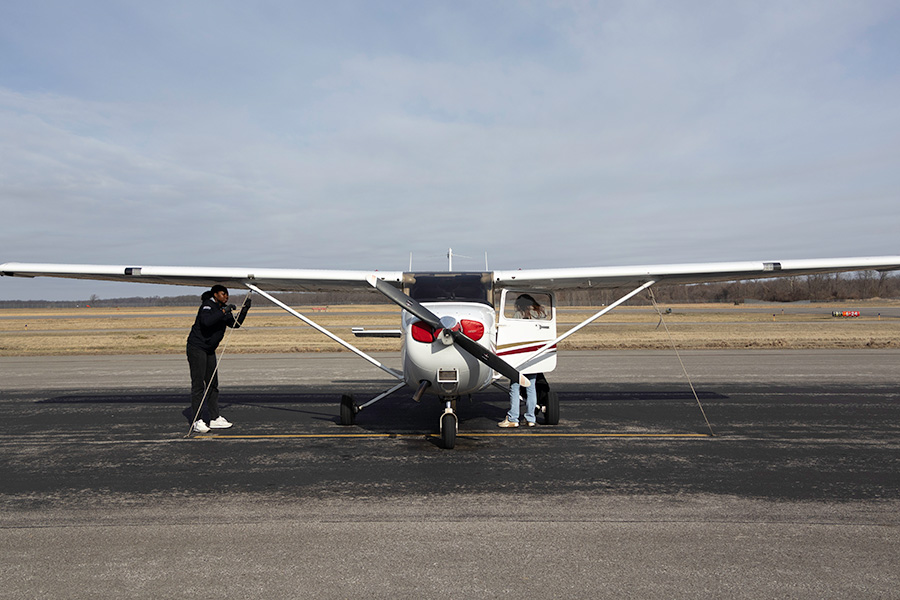
Saliu said staying at SIU to work after graduation was a no-brainer. Today, she serves as a flight instructor, working one on one with students who want to become pilots. Sometimes, she spends the class blocks in the plane with them, other times she spends them in a simulator or in her office.
This semester, she has six students, half of which are women.
Advertisement*
“That’s been fun. At first, I was scared about that, but I’m actually happy that I have female students, because I get to teach them and I can be that voice of reasoning,” she said, adding that the field can be hard, “so sometimes just having a familiar person, familiar gender could also help.”
Editor-in-Chief Carly Gist can be reached at [email protected].
Advertisement