On the evening of Sept. 27, more than 400 people — a mix of students, families and seasoned astronomers — gathered at the sprawling fields of the SIU Farms to share a view of the cosmos under the moonlit sky during the annual SIU Star Party.
For some, like SIU Philosophy Professor Randall Auxier, such an event held a significance that went beyond simply looking through telescopes; it served as an antidote to a modern form of isolation.
“For as long as there were humans, we lived with the Milky Way above us, until about 125 years ago, when the light on the ground occluded our vision,” Auxier wrote in an email interview with The Daily Egyptian.
Advertisement
“Now our stories are left to experts. We don’t feel qualified to tell a story about the universe without technical training … it makes the earth lonely. But I feel less lonely when I think about the shared night sky,” Auxier said.
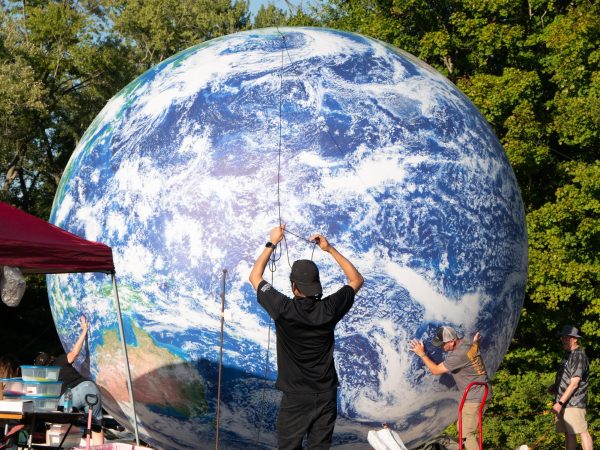
From the moment it began, the event was buzzing. At one table, STEM Education researchers helped children build models of the Earth and moon. At another, glow sticks were given out, creating crisscrossing paths of light in the growing twilight. For the student organizers, this energy was the payoff for six months of hard work in preparation.
“I love working in production,” said Brooklyn Lewis, a junior in SIU’s cinema program who helped manage the event. “It’s fun to collaborate with people … a lot of working parts like this make a whole big thing.”
Her colleague, cinema senior Kyleia Glass, agreed.
“This is a good, real-life learning experience that’s outside of class,” she said.
The event wasn’t just for university students. A group from the Saluki Entrepreneur Corps, which mentors college entrepreneurs, was also in attendance.
“We are here to volunteer,” said Noah Nekic, PR & Marketing Chair in the Saluki Entrepreneur Corps. “This is really cool. The big Earth is awesome.”
Advertisement*
As darkness fell, the main event began. Lines formed behind dozens of telescopes, each pointed at a different celestial wonder. The main attraction of the night was Saturn, which had just reached its opposition on Sept. 21, making it appear at its closest and brightest for the entire year.
“What you’re going to see is a very thin ring — a vertical ring,” said Harry Treece, president of the Astronomical Association of Southern Illinois. “It only happens every 12 or 13 years. That’s the coolest thing you’ll probably see tonight.”
The event was a showcase of expertise.
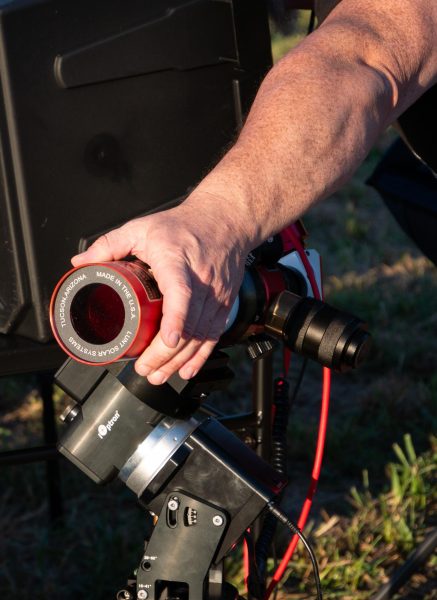
Marc Listello, an astrophotographer with the Michiana Astronomical Society who drove down from southern Michigan, had his complex rig of cameras and scopes aimed at a faint patch of sky. His target — the Squid Nebula.
According to Listello, the Squid Nebula is a faint, blue, oxygen-rich celestial body that is challenging but a rewarding target for an astrophotographer.
“That oxygen data is so faint,” Listello said. “It takes approximately 20 to 50 hours of imaging time to even pull up that pretty blue squid.”
For Corinne Brevik, an associate professor in SIU’s physics department and one of the event’s lead organizers, the night was a chance to share the science she loves.
“As every year, what’s in the fall sky is what’s in the fall sky,” she said. “But the clearer and the darker the sky is, the fainter the objects we can look at.”
And on this night, the sky was cooperating perfectly.
But seeing Saturn’s rings isn’t just a lesson in physics; it’s an experience that connects us to a long history of human wonder.
The light from that distant planet, after traveling for more than an hour, was ending its journey in the eyes of people in Carbondale.
“The scientific and astrological view of things sometimes came into conflict,” wrote David M. Johnson, a professor of classics at SIU, in an email to the Daily Egyptian.
He shared a story from 431 B.C., when an Athenian fleet saw a solar eclipse.
Their leader, Pericles, a student of philosophy, is said to have claimed that it was “nothing to worry about.”
But to most, it was a terrifying omen.
“The next year Athens was struck by a plague,” Johnson wrote, illustrating how for millennia, science and belief have been “intertwined in controversial ways.”
Auxier said he believes this search for meaning is fundamental to who we are.
“We believed they were persons and that they formed an orderly civilization,” he wrote. “It is natural that we tried to appease them when the stars crossed with us, and to praise them when we had good fortune.”
In a world now obscured by light pollution, he sees events like the Star Party as a way to reclaim that shared heritage.
As a longtime member of the Astronomical Association, Rue Tanner helps run the Library Telescope Program. Tanner’s passion extends far beyond a single night.
“Imagine a person walking into a public library with their kid, and a few minutes later they walk out with a telescope under their other arm — not a book,” Tanner said.
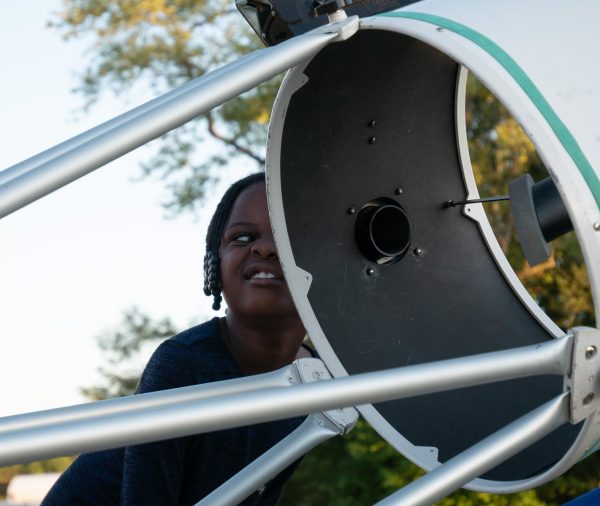
“There are now more than 1,000 libraries in the United States that have telescopes. Carbondale, Murphysboro, Marion, Harrisburg, Carterville — they all have them.”
This is how an event like the Star Party can turn a moment of wonder into a lifelong hobby and can make the cosmos accessible to everyone.
For those who missed it, the organizers are already looking ahead to the next celestial show, ready to once again share the sky. According to Brevik, there will be a series of SIU-led study abroad trips to “chase” the solar eclipse, both for students and SIU alumni. Upcoming trips include Spain in the summer of 2026, Morocco in 2027 and Australia in 2028.
“A total solar eclipse is an experience you almost can’t describe to someone,” Brevik said. “It is an experience you will never forget.”
Staff reporter Trevor John can be reached at [email protected]
Advertisement