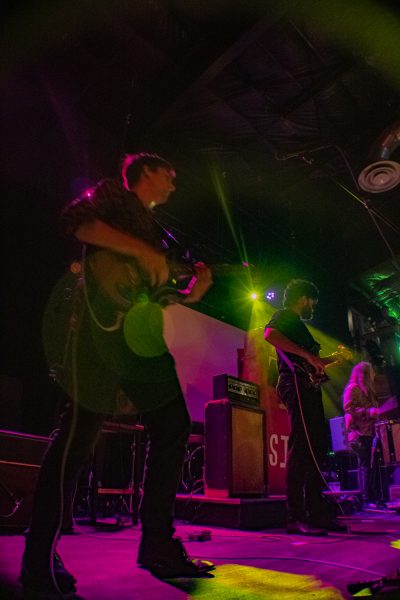
The Brooklyn-based post-punk art rock band Bodega ended its global tour in Carbondale with a performance on Friday, Sept. 26, at Hangar 9.

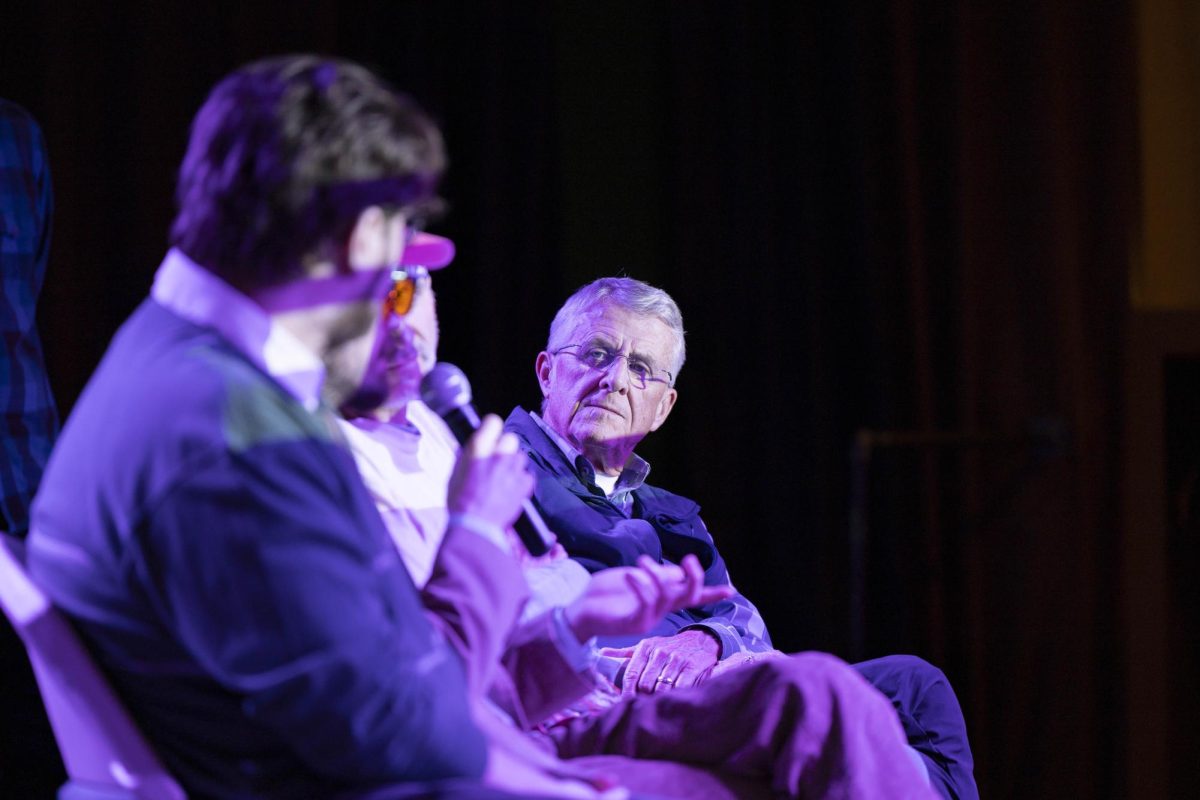
The band gave a lecture on the philosophy behind their music and art in Morris Library on Thursday evening. Bodega received a DIY cardboard ATM from the philosophy department that would be behind them on stage during their performance at Hangar 9. ATMs are symbolically significant in the band’s records, songs and artwork.
Advertisement
After arriving from opening for the Viagra Boys in Montreal, Canada, Bodega members Ben Hozie, Nikki Belfiglio and Adam See gave the Daily Egyptian an exclusive interview at Hangar 9 on Wednesday, Sept. 24.
The band said they were interested in lecturing on campus when SIU philosophy faculty reached out to them about the opportunity. Bassist See also had a personal interest in visiting the campus.
“I have a special connection with this philosophy department, not that I have ever been here before, but my favorite philosopher is John Dewey, and they have the Dewey Archives here,” See said. “I’m not even sure I would be the same person I am today if it wasn’t for that particular philosopher, so I have always wanted to come here.”
Vocalist and percussionist Belfiglio said that coming to a college campus was a unique opportunity to reach a wider audience.
Advertisement*
“The 50-, 60- and 70-year-olds are still our biggest fan base to this day, but we know there are young people who would really relate to what we are doing,” Belfiglio said. “But how do we reach them, because we can’t rely on the algorithm to reach people? We don’t want to stand with the algorithm. We want to actually go out there and speak to people ourselves.”
Post-punk, as defined by vocalist and guitarist Hozie, is influenced by philosophy, literature and fine art.
“The term (post-punk) has lost a lot of meaning,” Hozie said. “I think a lot of bands that are called post-punk now are not even remotely punk. Punk isn’t a sound. It’s an attitude. At the very basic level, it has to be against the status quo.”
The band does not mind being labeled post-punk since it allows them to find an audience and is accurate to the attitude and ideology of the band. But they do not want to be restricted creatively.
“Ultimately, we want our band to be bigger than one genre,” Hozie said.
Bodega’s discography draws inspiration from different types of rock and electronic dance music, from bands like The Smiths, Daft Punk and Radiohead. Their albums “Broken Equipment” and “Endless Scroll” are riddled with references from these genres, but their influence comes from more than just other musicians.
Filmmakers such as Jean-Luc Godard, novelists like James Joyce and philosophers like Martin Heidegger have heavily influenced the band and their music.
The band explained Heidegger’s example of how a hammer can be seen as an object for hammering nails, but when it’s broken, the hammer is seen as just an object and not as a means to an end. This core concept is expanded upon to phones, the internet and algorithms in their “Broken Equipment” album.
“We make broken music, for broken people, written by broken people,” Hozie explained.
When performing live at Hangar 9, Hozie would shout out the inspirations that fuel many of their songs, like the friend he lost on “Charlie” and the actress Gena Rowlands on “Knife on the Platter.”
Many of Bodegas’ songs are inspired by current events, social justice and like many post-punk bands, sticking it to the man. On the body of See’s bass was tape that read “Free Palestine,” and before playing their hardcore song “Guess What,” Hozie gave another shoutout:
“This is for the genocide in Palestine,” he said as the band began playing their fast-paced, heavy hardcore song.
Hozie said he likes rock that isn’t slick and clean, but rather, messy and damaged. This is reflected in the band’s music, especially in their new hardcore album “Rot In Helvetica.” This album is released under the band’s alter ego, NODEGA, and features tracks with faster tempos and more distortion.
NODEGA is the band’s way of messing with the internet and algorithm, and also a new potential creative outlet.
The percussionists of Bodega have a unique aesthetic — they are all standing and none of them sit at a drum kit. While she sings, Belfiglio plays the high-hat that See described as having “an electronic music function” that is separate from the drums played by Adam Shumski, making their sound feel different.
Hoize said that this emulated electronic beat is “in order to make rock ‘n’ roll relevant” to “21st century music like EDM and hip-hop.” The band members agreed that this gives the stage the presence of a theatre set.
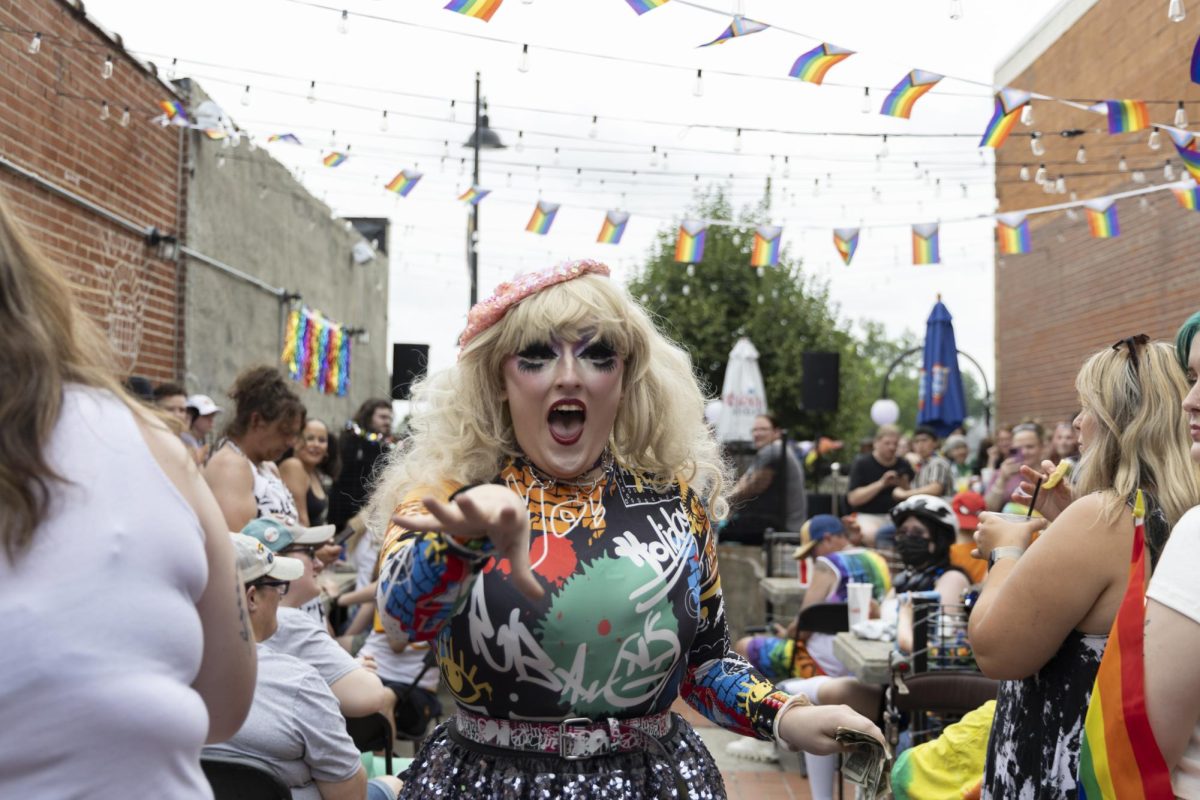
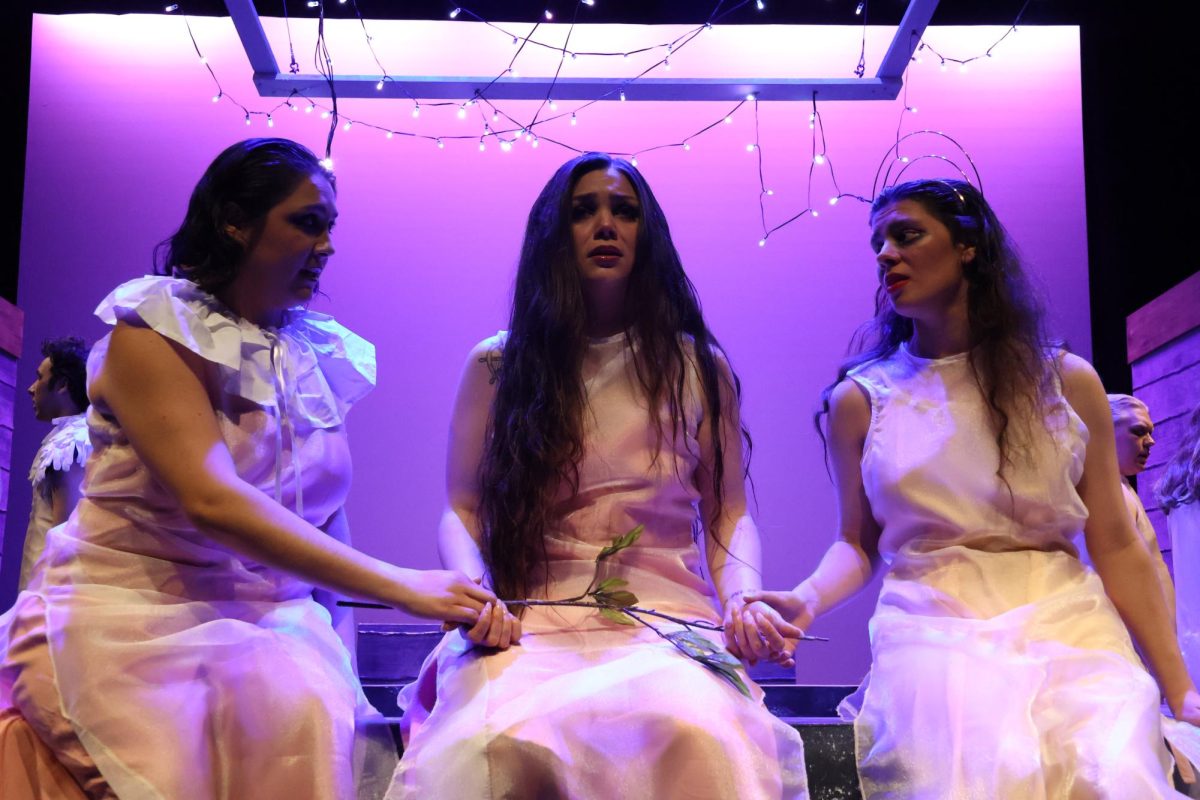
Bodega was not the only band to perform theatrically that night at Hangar; one of the opening bands, named Tr!cks, surprised and impressed audience members with its blend of rock and operatic vocals.
“At first, I was like, is this a warm-up or is this how it’s going to be?” An audience member named Christopher asked of Tr!cks’ performance. “Then she started, and it blew me away!”
“I like the riffs. The vocals were a little theatrical for my taste, but I like the style,” audience member Darren Snow said.
Tr!cks lead vocalist and guitar player Jane Doe has a degree in vocal performance, where she “studied more operatic and classical styles.” She said that the performance at Hangar 9 “was the full new album.”
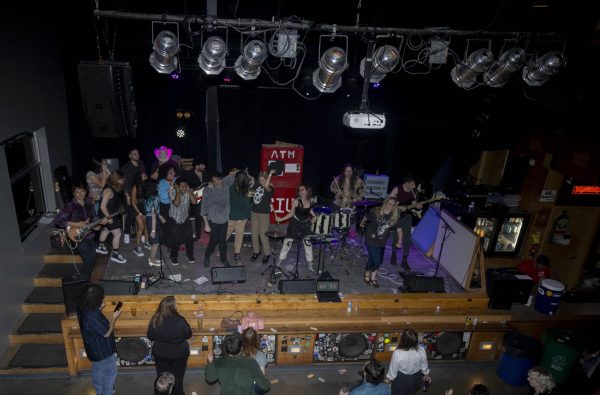
“This was our last show, and then we’re gonna go and record all winter and hopefully have a new album out soon,” Doe said.
Members of Tr!cks include percussionist Brandon Gill, bassist Andy Brower, vocalist and guitarist Jane Doe and guitarist Evan Neumann.
The second opening band, The Strumms, started with a spoken word performance by Nina Donovan, who goes by “Simp Goddess.” The poem covered a range of political and social issues, including but not limited to racism, misogyny, white privilege, wage gaps and the industrial prison complex.
“I’m from Nashville, Tennessee, and I’ve been doing spoken word since I was 16. So, I grew up doing poetry slams and performing at different events in Nashville,” Donovan said.
On performing with the Strumms, Donovan talked about the importance of the explicit and political nature of the band’s music.
“That’s the whole point of art,” Donovan said. “Throughout history, art has been at the forefront of activism. If you’re an artist, especially coming from Nashville, if you’re an artist in the south without a message, then you’re kind of a clout-chasing coward.”
Bodega is no stranger to the radical atmosphere of places like Carbondale. They began playing in punk houses in New York that are similar in nature and spirit to Carbondale’s Lost Cross and Commune, but they play at those spaces “less so now,” said Belfiglio.
Hoize said that in those kinds of spaces, there is no symbolic divide between the band and the audience.
“Even if we play at a place like this, we try to still encourage, like, yell something out,” Hozie said as he gestured to the stage in Hangar 9. “Let’s have a conversation. You wanna hear a certain song? Tell us, we’ll play it. Nikki often brings people up on the stage to either grab an instrument and jam with us or to dance.”
The band said that with “more engagement” comes more “money, separation and bigger stages” like in Pink Floyd’s “The Wall.”
“I could see if the band, you know, gets bigger than what we already are,” Hozie said, knocking on a Hangar 9 wooden table, “maybe we could do the smaller shows as NODEGA.”
The band delivered on this sentiment of bringing people on stage and interacting with the crowd. During their song “Territorial Call of the Female,” Bodega had crowd members join them on stage and dance while the band performed. Belfiglio would bring her microphone down to the crowd so they could sing along during the choruses of multiple songs.
On their track “Tarkovski,” the band played an improvised bridge after the guitar solo, a traditional spectacle of all their live performances. This improvised bridge, as the song states in its chorus and adlibs, took the audience “to the zone.”
A unique spectacle occurred during Bodega’s song “Quantify” when the band had Dalton Winfree from The Strumms and the SIU philosophy department destroy the cardboard ATM featured during the performance with a baseball bat. Winfree then threw it out into the crowd, where a few members of the audience further ripped and tore through the fake automatic teller machine. Its cardboard carcass lay with the crowd for the rest of the performance.
Bodega’s music takes stances against mindless consumption and late-stage capitalism with fast and constant lyrics on tracks like “Doers” and “Can’t Knock the Hustle.” The band covers other serious topics like sex work and masculinity within “GND Diety” and “Jack in Titanic,” respectively.
The band’s lyrical songwriting can be what brings listeners in, or what pushes them away.
“One of our biggest critiques from people will be like ‘Yeah, I like you guys, but your lyrics are too on the nose,’” Belfiglio said.
“They think we are just saying, ‘Oh, you’re on your phone too much,’ but there is a lot more to it than that,” Hozie added.
Faced with this criticism, the band said it does not want to create surface-level art and wants to challenge listeners.
“Popular music listens to itself for you,” See said, citing philosopher Theodor Adorno. “Don’t worry, you’re not going to miss anything.”
Bodega members said they are a band that wants to be present with the audience and have an intellectual conversation with them.
“We respect our audience and we think they like being challenged,” Hozie said.
While intellectual conversation is an important part of Bodega’s music, they also put on a performance that encourages audiences to dance, sing along and express themselves in fun ways that draw fans in.
Crowd members Colleen and Martin Ewell said they came from St. Louis to see Bodega at Hangar 9.
“We picked up the album and we have listened to them ever since,” Martin said.
Some audience members had never heard of Bodega and gave the show a shot, like Jaiden Mitchelle.
“I have never gone to a random show before, but I absolutely fell in love with these guys,” Mitchelle said. “I ended up buying their t-shirt. I got the vinyl, I have like three vinyls at home, and one of them is these guys.”
When asked if they would play again at Carbondale, Bodega members Belfiglio and See said “hell yeah” and “absolutely.”
Staff Reporter Brayden Guy can be reached at [email protected].
Advertisement