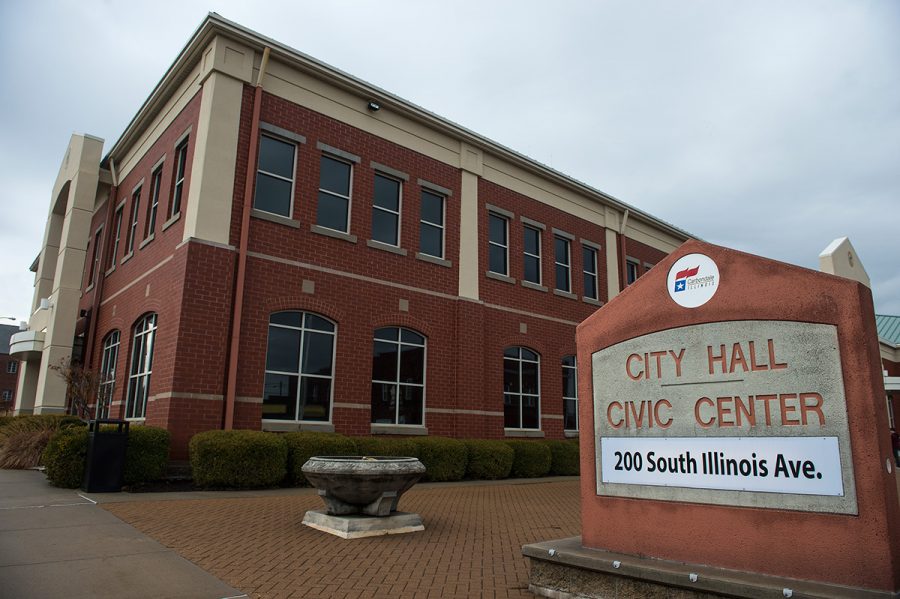
The Carbondale City Council did not take action on an ordinance that would have banned public camping in the city after three hours of public comment in a special meeting Friday morning. The public offered alternative approaches to addressing homelessness in Carbondale, and the City Council offered their own ideas as well.
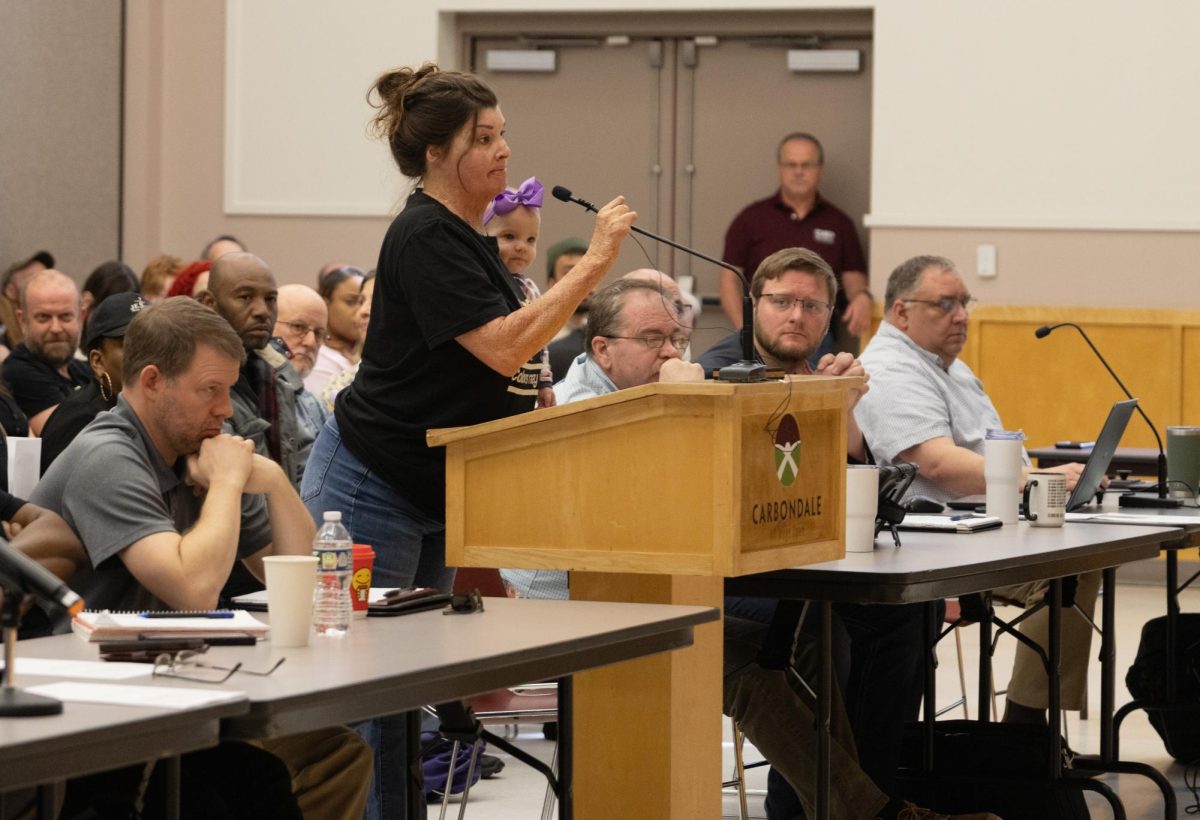
The council chamber was filled with people, and more chairs were brought into the already crowded room to account for more residents and neighbors who had come to comment on the ordinance.
Advertisement
The proposed ordinance would have declared public camping to be a “nuisance,” which is defined as “‘a significant and unreasonable interference’ with the rights of the public,” according to Justia.
The ordinance included an exception for camping on land that the city authorized for the specific use of public camping. If adopted, it would have imposed fines on those who violate that.
According to the meeting agenda packet, the ordinance was introduced to create a structure of clear, set rules on the use of public property for camping and to address health and safety concerns involved with such encampments.
Advertisement*
Alongside this ordinance was another item of discussion regarding the standards of communication between city staff, City Council and the city manager.
Public camping ordinance yields high turnout and new perspectives
Upward of 75 people came to the meeting, many among them came to encourage the City Council to stand against the ordinance and suggested alternatives to such a decision.
“Criminalizing homelessness is a nonstarter,” Erikah Buker, who lives at the homeless encampment on East College Street, said during public comments. “You are putting people that are already ground into the dust into a pattern of further grinding,”
Buker also discussed how the encampment, which has become the only shelter for over 40 people, had also become overloaded with trash.
“So many people use us as a dumping ground, to take their old closets that they don’t wear anymore, to take their old bedding that’s worn out, to take their food that’s expired, and dump it in our laps in the guise of charity,” Buker said. “It’s all just garbage that gets put on our front porch.”
For Buker, sanitation was also an issue. Buker described what it was like to wait for the bathroom every day: one porta-potty shared by the entire encampment.
“I don’t know about you, but have you ever lived in a house where you had to wait for the bathroom? That’s every day,” Buker said. “And it’s no shower. No shade. It’s a porta-potty everyone’s waiting for.
“Don’t get me wrong, I am glad to have it. I’m very glad. But it’s too little, too late. It’s putting the cart before the horse. It’s taking the problem and making it a solution. This is backwards thinking the whole way around.”
Chastity Mays, co-administrator of The Little Resource Center, which serves families and parents in Carbondale, talked about her experience with one of her clients.
“I recently had a pregnant client who was homeless,” Mays said. “She had to get an ID and a birth certificate, she has no address. Those things cost money. That is a rolling circle. If you don’t have an ID, you don’t have a birth certificate, you don’t have a social security card.”
That client, according to Mays, was able to obtain those documents and is on the way to more permanent housing.
“It’s going to take a local, a national and a clever collaboration,” Mays said. “It’s going to take all of us to work together.”
One more broad proposal from the community was from Deborah Gates, a resident of Carbondale.
“I propose that the City Council use us, the community members, as a resource, those of us who are passionate to do something to help end homelessness, to propose a coalition made of those of us who are interested in ending it and that we work with the city on proposals and ideas and actualization,” Gates said.
This idea of a more community-based group was repeated throughout the meeting.
Council members Adam Loos and Nathan Colombo also suggested that those who can and are willing should offer a place in their home for a homeless person.
In an interview with the Daily Egyptian, Colombo said, “We’re not saying everyone needs to open their doors tomorrow, but there are folks that are interested in that in our community.”
“It’s one of those radical ideas that cost us nothing to produce,” Colombo said.
Council member Clare Killman also offered her own suggestion as to how Carbondale should model its approach to homelessness. She had done research into Finnish law regarding their housing first policies.
“The model emphasizes stable housing as a basic human right and creates a triage approach to managing substance abuse or mental health issues that could be contributing to a state of chronic homelessness,” Killman said.
“Finland was able to convert former shelters into permanent housing units,” Killman said. “They were able to partner with government and nongovernment agencies to build new housing for the homeless. And they’re currently set to eradicate homelessness by 2027.”
She suggested Finland’s model as something that could potentially be done similarly with vacant housing units in Carbondale.
Council member Dawn Roberts pointed out how different Finland and the United States are, citing Finland’s immense federal support for eradicating homelessness and keeping people off the streets, as well as their smaller population, which makes it easier to implement on a smaller scale.
“There are definitely lessons to be learned from that model, but we are definitely very different,” Roberts said. “Our town does not have the financial resources or the federal support for something that broad.”
Most people were concerned about how the public camping ban would affect the homeless encampment on East College Street.
However, Donald Monty, a former City Council member and current resident of Carbondale, raised the question on the specific wording of the ordinance that seemed to include people sleeping in their vehicles.
“That is one provision in the code of this proposed ordinance that applies everywhere,” Monty said. “It’s not restricted to just public property. Which means that if my neighbor has weekend guests, and they come in their RV, and they sleep in their RV, they’re violating the ordinance.”
Colombo assured the audience that the city isn’t ignoring homelessness.
“We are all working on this issue, consistently we find ourselves tripping over the way that we come forward and we present how we are going to work on this issue,” Colombo said.
He said he created a PowerPoint of a nonexhaustive list of ideas to address the issue from City Council members, himself and the public.
He said in an interview, “They are all just somebody else’s ideas that I’ve tried to collect into one big bucket here.”
“You will not agree with everything, you will not like everything, but it will be something to chew on,” Colombo said at the council meeting.
He encouraged those who wanted a copy of the presentation to email him at [email protected].
Killman discussed how some members of the council, including herself, had also experienced homelessness to varying degrees.
“I think the easiest way to think about suffering and certainly the laziest is that suffering is deserved,” she said. “That someone must have done something to deserve the way that their life has led.
“I think that creates kind of an emotional cheat code to separate ourselves from the people who are around hardship. It’s so much easier to punish or judge others and save your ego than it is to admit we’re all much closer to experiencing suffering than we can admit.”
In Champaign, Illinois, a similar ordinance was proposed to ban public camping in the city, according to reporting by the Daily Illini. The Champaign City Council voted against it after the public voiced their concerns.
Champaign operates similarly to Carbondale in the fact that it is a college town, and a “sanctuary city” for the neighboring towns that do not have the same resources.
A common complaint among the community members that attended the meeting was the short notice. The city did not announce the meeting until Wednesday, and the meeting took place on Friday at 9 a.m.
Colombo discussed with the Daily Egyptian how the ordinance item might have appeared to the public, considering the standard format of the agenda item.
“It landed as if we were trying to sneak in and vote on this camping ordinance. When the reality is, there are not the votes there, I think, as it stands to pass this ordinance as it is,” he said.
City Council discusses concerns over breakdown of communication between the city and the public
While the room was filled with community members wanting to voice their concerns over the ordinance, the special meeting also included discussion about the boundaries and expectations on communication between city staff, the city manager and City Council members. The discussion was extended to refer to the public, as well, as the conversation continued.
By the end of the ordinance discussion, most of the public had left the meeting; however, the discussion continued to involve concerns over homelessness.
Council member Brian Stanfield said communication can help everyone coordinate resources.
“The more we can be armed with information ahead of time helps us to communicate to other people so they don’t feel like they’re getting caught with two days’ notice for a meeting,” he said.
Though the special meeting was an exception, lack of communication on when a meeting happens becomes something that reflects badly on the image of the City Council, Stanfield said.
“Even though it might not be a city-sponsored event, it’s the sort of thing that when we want to coordinate our resources for something like the homeless situation if we can’t even coordinate our notification for council meetings,” he said. “That’s a bad precedent and a bad look.”
Killman was a delegate to a think tank called Local Gov 2030, which brought together local government employees trying to find solutions to different community issues.
“One of three key problems all local government employees throughout the country identified among themselves was the difficulty of communication with the public, with each other, with electeds. It was pervasive,” Killman said. “Current government communication models rarely work well and have led to continued declines overall in the United States in public trust.
“They’ve contributed to sporadic or low engagement with communication efforts, misunderstanding as to what we even do as local governments and they lead to the general feeling that what cities actually do is reactive and transactional,” Killman said.
She offered the studies from Local Gov 2030 to the rest of the council for consideration on their own time.
News Reporter Orion Wolf can be reached at [email protected] or orionwolf6 on Instagram
Advertisement