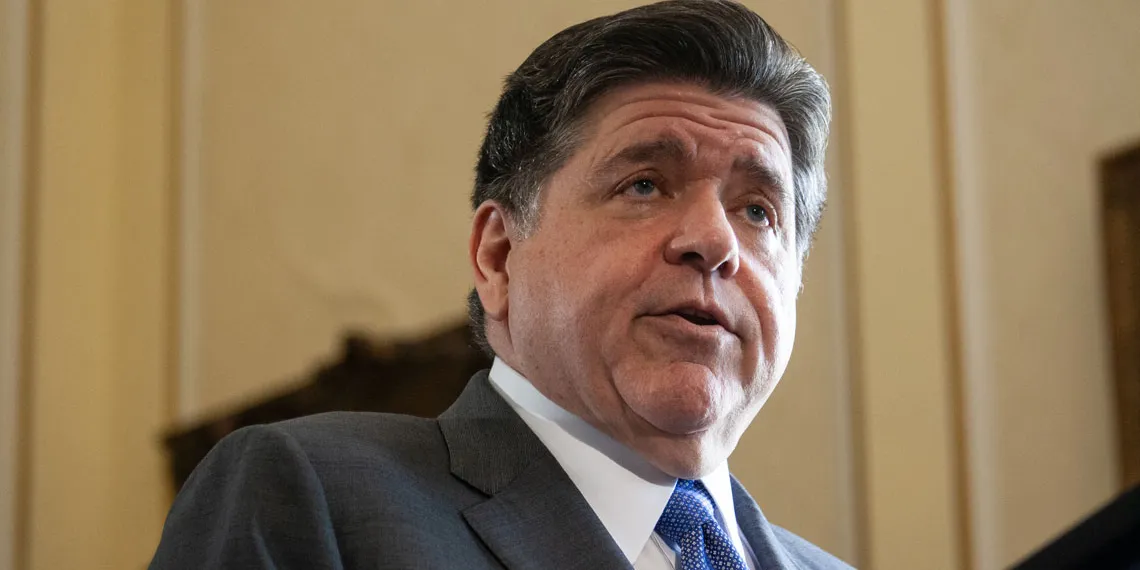
2026 marks another year of elections in Illinois. The Daily Egyptian interviewed the two candidates running for the U.S 12th Congressional District Representative seat: Democrat Julie Fortier and Republican Mike Bost.
Both of these candidates have an easy primary lined up as they are the only candidates in their respective parties. Regardless, the primary election will be held on March 17. Then Fortier and Bost are expected to run against each other for the general election, which will be held Nov. 3.
Advertisement
Bost is the incumbent and has served as the 12th District representative since 2015, having also been a state representative for over 20 years. A Murphysboro native, Bost graduated from Murphysboro High School and served in the Marines. He described the 12th District as “home.”
“There are good people, older people, who came from farming and mining and are hardworking,” Bost said. “Unfortunately, we have seen some bad times in Illinois because quite often the laws are stripped, painted and pushed towards what Chicago wants.”
Fortier has lived in O’Fallon for over 30 years. She served in the Air Force and has a Ph.D in pathology research.
Advertisement*
Fortier described the 12th District as “large” and “diverse.”
“When you look at this district and you look at the stats, as far as size, this district is 14,000 square miles – which is huge,” Fortier said. “It’s so diverse. Of that 14,000, over 10,000 of that is farm land. Within that you have over 18,000 farms, you have over 31,000 farmers, you have cities that have white collar workers, you have towns, labor unions, a coal mine in the south, an oil refinery in the north, we have community colleges and some universities. We have populations from every race, every gender and every religion. It is a true representation of America.”
While the 12th District does have populations made up of many different races, according to the US Census Bureau, it is 87% white.
“It’s not like going into downtown Chicago,” Fortier said. “You won’t find farmers in downtown Chicago. You won’t find coal miners in downtown Chicago.”
Fortier said that her background in research and scientific writing gives her a unique perspective and certain advantages as she goes to challenge Bost.
“I assess data very fast, and I come up with solutions very fast. It’s just how I’m wired. If I don’t know something, I go and research the truth. I cannot make decisions if I am uninformed,” Fortier said.
As the incumbent, Bost`s representative duties can take him out of the district often.
“But if we are not in the district, we do a lot of tele town halls, usually once a month,” he said.
Bost’s telephone town halls have been controversial since they started in 2017. In March of last year, a protest was held outside the Jackson County Courthouse because protesters felt their voices were not being heard.
The 12th District has voted Republican consistently since 2015. As a Democrat, it could be difficult for Fortier to win over a district that has voted for Bost for the past decade.
“I am hoping that they (the constituents) understand that this district has had very little representation,” Fortier said. “Just because he (Bost) might be in their party does not mean he is in their best interest. I think that has come to light with the ballot bill he is trying to put through. He does not want mail-in ballots past election day, which totally impedes military people — especially military people who are deployed.”
Fortier is referencing the SAVE ACT, H.R. 22, a bill co-sponsored by Bost, that would require individuals to provide documentary proof of their U.S. citizenship to register to vote. This would force people deployed overseas to come back to America if they wanted to register to vote.
“I want these people to know that I will be a voice for them,” Fortier said. “I don’t care what political party people are. I will be the best voice I can be for this district.”
Much of southern Illinois is farmland, and soybeans account for more than 1.1 million of the region’s 2 million row crop acres. Tariffs have caused China to buy fewer soybeans in 2025; historically, the country has bought 40% of Illinois soybeans. The U.S. exported 26.8 million metric tons to China in 2024, but only exported around 18 million metric tons in 2025, according to Farmdoc. President Donald Trump implemented these tariffs starting in January 2025 in an attempt to reduce trade deficits.
Bost said that the “previous administration did not request any trade promotion authority,” which are statutes that can give the president power to alter tariff rates and negotiate on trade agreements. The 2015 trade promotion authority expired in July 2021, and the Biden administration did not renew it, instead choosing to use new models like the Indo-Pacific Economic Framework for Prosperity, according to the Library of Congress.
“Now we have a president who really knows how to negotiate those trade deals,” Bost said.
“When we start talking with our soybean farmers, and understand I have been not only endorsed by all of the ag groups, but I have also been working with them side by side every day, making sure their message is taken forward,” Bost said.
Bost serves on the House Committee on Agriculture and is the chairman of the House Committee on Veterans’ Affairs.
“What Trump has done is he has pushed (China) into a situation where they have to come back to the table,” Bost said. “No one ever has been a president of this nation who knows how to make a deal and how to get people to the bargaining table.”
Bost said to remember that China’s leader is imperialist, so “they are going to play for the long game.” He also said that China “drives the market up,” which causes farmers to overorder.
“We are trying to get through that, and with these tariff negotiations, that is what we are trying to do,” he said. “See, the ag people understand that, that tariff money is going to come back to help some of our farmers. We are trying to put that together at this time. That is the advantage of being on the ag committee.”
China has bought more U.S. soybeans recently, which has helped the market. But even with the Trump Administration’s $12 billion Farmer Bridge Payments, farmers are suffering as they stand to lose between $33 billion and $44 billion, according to Reuters.
“We are keeping abreast of it as members of the ag committee. Are we worried? Well, I’ll tell you what, if you actually represent farmers or are a farmer, you worry all the time,” Bost said. “Is it going to be too hot? Is it going to be too cold? Is it going to be too dry? Is it going to be too wet? What are the prices going to do? More concerning than even the market with China is the market terms we have right now of the input cost.”
Concerning the same soybean dilemma, Fortier had some ideas, but could not expand on them yet.
While she may not be affiliated with the Agricultural Committee like Bost, both have respect for farmers.
“You’re banking on a good crop to sell,” Fortier said. “So when the market goes down, you have to weigh the odds. Do I sell at a reduced price and hope to recoup some of my loss, and will that loss compensate for everything I have invested? Or do you hold onto it, hoping that there is a market next year or at the end of this year? They still have bills. A lot of farmers work two jobs.”
Fortier did not agree with the recent use of tariffs.
“What I have heard time and time again from farmers, whether it has been online or whether it is the farmer I have spoken to — it is interesting because you take the tariffs, and it’s almost like you’re paying yourself,” Fortier said.
She further explained that tariffs created an odd cycle.
“For instance, let’s say my tractor falls apart. I have to go buy the part to fix my tractor. There is a new tariff on that. So now I am paying the tax that’s going to go to America. So let’s say I pay $10 tax on this. So now I fix my tractor, and America is like, I’m going to give you tariff money to help you with not being able to sell soybeans. So the farmer is like, ‘I’m just paying myself?’”
In addition to tariffs, President Trump announced in late October of 2025 a plan to quadruple beef imports from Argentina. This created concern and backlash from cattle ranchers, and caused Bost to have some concerns of his own.
“I am also very concerned because, in my district, one of the largest meat processing plants is getting ready to be built, and we want to make sure that the market is there and allows our farmers to make profits, and that is what I will argue for,” Bost said. “I have concerns, but I understand that the Argentinian beef is specifically for the lower-grade hamburger.”
Fortier acknowledged that it was a low-producing year for beef and that President Trump gave money to Argentina to “lower the price of beef,” which Fortier said, “does more for Argentina than our beef farmers.”
She also brought up President Trump’s relationship with President Javier Milei and how it tied into the soybean market.
“Trump likes Argentina, he wants to buy the peso, so he gives them $20 billion. Well, that then got increased to $40 billion because he likes the gentleman who wants to become president again in Argentina.”
Another concerning matter for southern Illinoisans is health care. Just recently, 17 Republicans joined Democrats in the House to extend the Affordable Care Act subsidies, but Bost stayed aligned with the GOP leadership.
Bost has long been an opponent of the Affordable Care Act, also known as Obamacare. Many Americans are worried about the price of premiums if the tax credits of the Affordable Care Act are not extended. This was one of the major issues that caused the longest government shutdowns in our nation’s history.
Bost said he favors market-driven competitive solutions to health care rather than socialized or government-subsidized health care. He said that “if someone is competing for your insurance bid,” then that competition “reduces the overall cost of insurance.” Instead of the government subsidizing, which is “calling winners and losers.”
Bost gave an example of one of his constituents and his problem with the health care system:
“I got one guy who called me… and he is in my district, he pays like $5 a week for insurance, $30 a month with his employer, but if all of a sudden he goes from making $106,000 a year to $107,000 a year, now his insurance climbs to $800 a month and a $5,000 deductible. That’s the problem with government-run health care.”
Bost said he is going to do something for the long run and “not just the short run.”
Fortier talked about times when she had struggled with insurance.
“I don’t think people realize if you have never been without medical insurance — there has been a time when I did not have medical insurance — how scary it is. You never know if an accident will occur,” Fortier said.
Fortier said she believes in universal health care.
“Americans deserve health care. We deserve universal health care,” Fortier said. “Nobody can afford to live in this country without health care.”
This example is not necessarily “socialized health care” because universal health care just means that everyone has access to health care, and socialized health care would mean the government owns and distributes all health care.
The DE interviewed Fortier on Oct. 25 and Bost on Dec. 5, 2025.
Staff Reporter Brayden Guy can be reached at [email protected].
Advertisement